Bee PALS • Free Foundation 01
Regulation Helps Me Notice
When my brain or body needs support, it can be harder to notice what is happening around me. I can use what helps me, then notice one clue at a time.
Before you start
How are you using Bee PALS today?
The big idea
I do not have to look calm to be ready.
Regulation does not mean sitting still, making eye contact, or hiding how I feel. It means noticing what my brain and body need so I have enough access to learn, communicate, and notice what is happening.
Regulate
Get enough access to notice.
I can check in with myself before I try to figure out what is happening around me. There is no correct body to have. I am gathering information.
What am I noticing in myself?
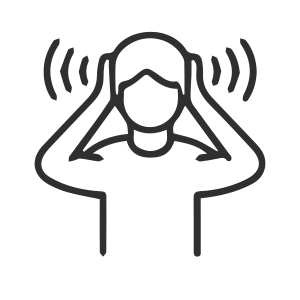 Too much around me
Noise, movement, light, talking, or too many things at once.
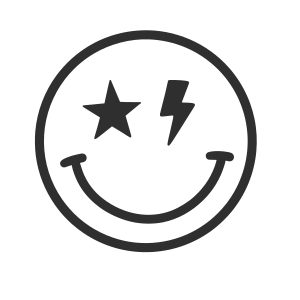 I need movement
I may feel restless, fast, wiggly, or like I need to move.
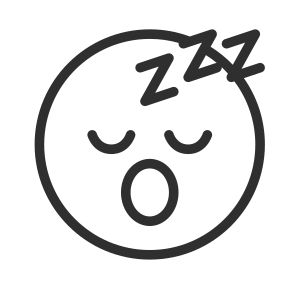 My energy is low
I may feel tired, slow, foggy, or need extra processing time.
 My feelings are taking up space
I may feel worried, frustrated, excited, upset, or unsure.
I may feel more than one of these. I may feel something different. I may not know yet.
What might help?
See
See what this can look like.
Social information can be easier to notice when I have enough access to the situation. I can notice in the way that works for me.
There are clues around me that can help me understand what is happening.
Sometimes my brain or body is handling a lot. Clues may be harder to notice then.
I can use support that works for me, like movement, a break, a sensory tool, or more time.
I do not have to make eye contact or keep my body still. I can notice in the way that works for me.
When I am ready enough, I can notice one clue at a time: situation, words, voice, face, body, or space.
If I miss a clue, I can ask, check, or get more information. Missing a clue does not mean I failed.
I can use hearing, vision, context, words, movement, AAC, or other information available to me.
Try
Try a low pressure example.
Situation
You are playing a game with another person. The room feels loud and your body feels restless. The other person says something, but you do not catch all of it.
Practice the pattern
What is my brain or body telling me?
What might give me better access?
What is one thing I can notice?
Do I need more information?
Words I can use
- “Can you say that again?”
- “I need a minute.”
- “It is hard for me to hear in here.”
- “Can we move somewhere quieter?”
- “I am not sure what you mean.”
- “Can you show me?”
Do
Use it once in real life.
Your mission
Notice your access before one social moment.Before a game, conversation, class, outing, online chat, or other activity, ask: “Do I need anything before I try to notice what is happening?”
Success is noticing what you need. You do not have to use a support every time.
Reflect
What did I learn about myself?
Reflection can be quick. Tap an answer or add your own words if you want.
Did anything help?
What helped or might help next time?
Want to add more? Optional
You noticed, tried, and learned. That is the goal.
For support people Parent, caregiver, teacher, or therapist coaching
Coach access, not appearance.
If a learner misses a cue, first consider whether noise, language load, processing time, sensory input, uncertainty, fatigue, anxiety, or another barrier made the information harder to access.
Offer supports without requiring the learner to earn them.
Point out useful information without demanding eye contact or one type of attention.
Practice one small example. Allow more than one reasonable response.
Look for one natural opportunity during the week instead of forcing repeated practice.
Ask what helped, what was hard, and what the learner wants to try next.
“That was a lot to take in. What would make it easier to notice what is happening?”
About this Bee PALS lesson
Bee PALS uses a predictable learning sequence: Regulate, See, Try, Do, Reflect. The goal is to make social information easier to access, practice, use, and think about while respecting individual communication and sensory differences.
This lesson is educational and is not a substitute for individualized assessment or therapy.